Why Your Garage (or Add-On Room) Is the Hottest Space in Your Yuma Home
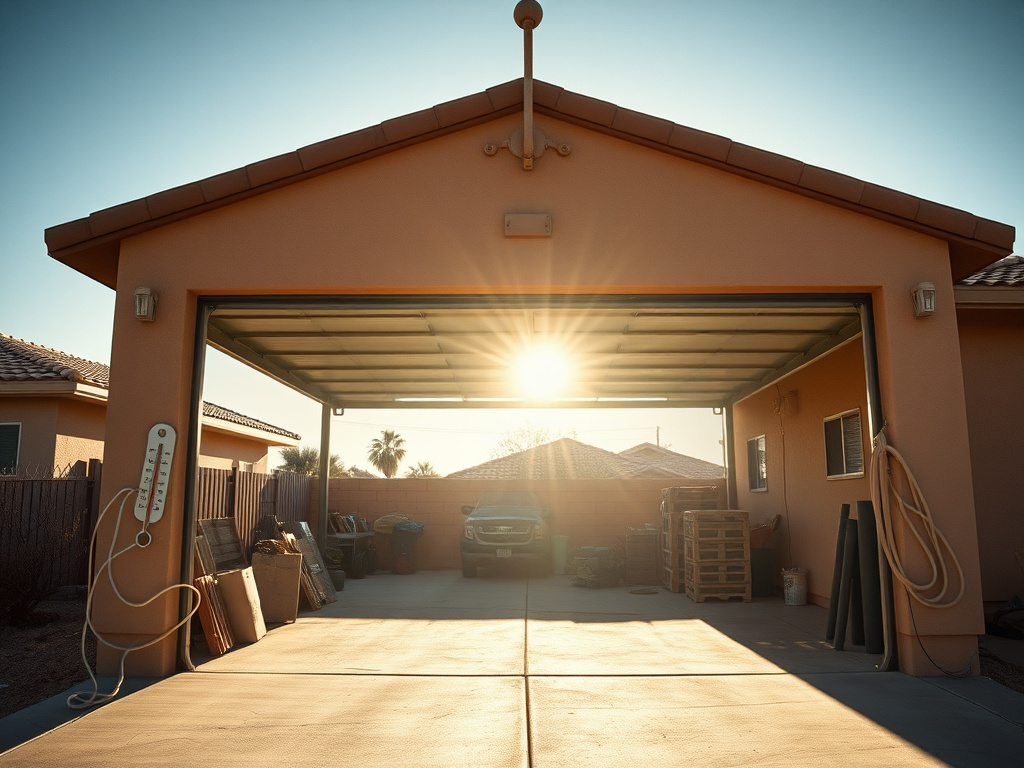
If there's one space in a Yuma-area home or property that owners consistently describe as unusable in summer, it's the garage — or whatever's attached to it. It's not a coincidence, and it's almost never a sign that the AC unit is undersized. It's a direct symptom of an uninsulated garage ceiling and wall assembly sitting under some of the most sustained direct sun of any city in the country.
Why garages run hotter than the rest of the house
A standard garage door is not a strong thermal barrier, and many Arizona garages have minimal or no wall and ceiling insulation to begin with. Combined with direct sun exposure on an attached garage's roof and walls in a city averaging more than 4,000 sunshine hours a year, the space can sit well above outdoor air temperature through the hottest part of a Yuma afternoon. That heat doesn't stay contained inside the garage — it moves.
Where the heat actually goes
- Through a shared wall, into any bedroom or living room built next to the garage
- Through the garage ceiling, into a bonus room, guest room, or media room built directly above
- Through the garage door and service door framing, if those areas aren't properly sealed
That third pathway matters more than people expect. Even a well-insulated wall assembly can leak heat around door framing and penetrations if the gaps aren't sealed — which is exactly what spray foam addresses that batt insulation, laid loosely into a cavity, does not.
A distinctly Yuma problem: manufactured homes and add-on rooms
Yuma draws roughly 90,000 winter visitors each season, and the area has a correspondingly large stock of manufactured homes, park models, and RV-adjacent housing — much of it built with minimal factory insulation to begin with. A converted garage, an added Arizona room, or a shop attached to a manufactured home often heats up faster and more severely than a comparable space in standard site-built construction, since factory wall and roof assemblies are typically thinner. These structures are some of the most common, highest-impact garage and add-on insulation projects we handle in the Yuma area.
What actually fixes it
Spray foam insulation on the garage ceiling, the shared walls between the garage and living space, and around door framing closes the heat pathway at its source. We typically recommend closed-cell foam for garage applications specifically — garages see wider temperature swings and more dust and exhaust exposure than interior rooms, and closed-cell's density and moisture resistance hold up better under those conditions.
Frequently asked questions
The most noticeable improvement is in the room(s) directly affected — an above-garage bonus room or a bedroom sharing a garage wall. There's typically some whole-home benefit too, since a hot garage can radiate heat into adjacent ductwork or attic space, but the biggest, most immediate difference shows up in the specific room next to or above the garage.
Yes — this is one of our most common project types given Yuma's large manufactured-housing and winter-visitor population. Factory insulation on these structures is often minimal, and an attached garage, shop, or add-on room can be one of the highest-impact, most contained projects we do.
Ready for a free quote?
Tell us about your home and we'll build a clear, no-pressure quote.